04FEB

Most small businesses in Chennai already do some digital marketing — a Google Business Profile here, an Instagram page there, maybe a few boosted posts around a festival. What is usually missing is not effort, but a strategy connecting that effort to a specific business goal. This guide walks through how to build one, channel by channel, without assuming a large budget or an in-house marketing team.
A digital marketing strategy is simply the set of decisions that determines where your time and budget go, and why. It answers three questions before any campaign starts: what result are we trying to produce, who exactly are we trying to reach, and which channels are the most direct way to reach them. Without those answers, marketing becomes a list of activities rather than a plan.
A small business rarely has the budget to be mediocre on five channels at once. Strategy is what lets a limited budget behave like a focused one — it tells you which two or three channels deserve the bulk of your attention this quarter, and which ones can wait. Without that filter, it is easy to end up busy on social media, present in search, and running ads, while none of the three gets enough consistent effort to actually produce results.
Start with a single, specific goal for the next three to six months — more enquiries for a particular service, more footfall at a physical location, more repeat orders from existing customers. A vague goal like "grow online" does not point to any particular channel; a specific one usually does. More footfall points toward local search and maps. More enquiries for a considered purchase points toward search and a stronger website. Repeat orders point toward content and social media that keep the business visible between purchases.
Different goals also mean different audiences, and different audiences behave differently online. A customer looking for a nearby service right now searches Google with immediate intent. A customer researching a bigger purchase reads comparisons and reviews over several days. A customer who already knows your brand mostly needs a reason to come back, which is closer to a social media and content job than a search one. Writing down who you are actually trying to reach — and what they are likely doing online when they need what you sell — makes the channel choice in the next section far easier.
Before adding anything new, look honestly at what already exists — the website, the Google Business Profile, any social accounts, any past ad campaigns. Most small businesses find at least one asset that is already half-built and simply needs finishing, which is usually a faster win than starting a new channel from zero. A Google Business Profile missing photos and categories, a website with an outdated services page, or a social account that stopped posting six months ago are all more valuable to fix first than to abandon in favour of something new.
There is no single right channel mix — it depends on the goal and audience defined above. What follows is what each channel is actually good at, so you can match it to your situation rather than adopting all of them at once.
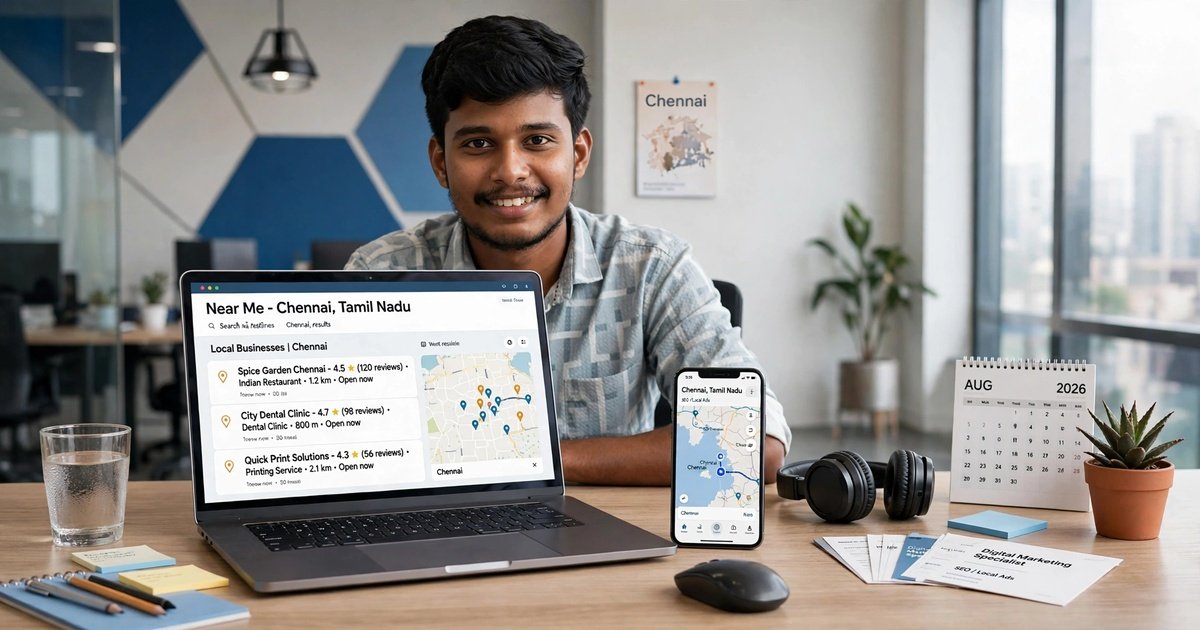
For any business serving customers in a specific area of Chennai, local SEO is usually the highest-leverage starting point — it captures people who are already searching for what you offer nearby, which is about as close to ready-to-buy as search traffic gets.
A more detailed walkthrough of what this involves is covered in how local SEO helps Chennai businesses grow, including what to prioritise on your Google Business Profile first.
Google Ads is the fastest way to appear in search results while your organic SEO is still building up, since local rankings usually take months to establish. It works best for services people actively search for — plumbers, clinics, repair services, consultants — rather than for building awareness of something nobody is yet searching for.
If you are weighing search ads against social ads for your first campaign, this comparison of Google Ads vs Meta Ads breaks down which one suits which kind of buying intent.
Social media is generally better at building familiarity and trust with an audience than at generating immediate enquiries. It suits businesses with a visual product, a longer sales cycle, or repeat customers who benefit from staying connected to the brand between purchases.
Instagram in particular remains one of the more accessible platforms for a small business to start on — a practical look at what is working on Instagram right now covers formats worth trying first.
Every other channel eventually sends people to your website, so a slow, outdated, or confusing site quietly undermines all of them at once. Before spending on ads or content, it is worth checking whether the website itself explains what you do clearly, loads quickly on a phone, and makes it obvious how to get in touch.
If your site feels outdated, it helps to first work out whether it needs a full rebuild or just a redesign — this comparison of website redesign versus rebuild is a useful starting point for that decision.
Content — blog articles, guides, answers to common customer questions — is what feeds both search and social media over time. It is a slower channel than ads, but it compounds: an article written once can keep attracting search traffic for years, and it gives social media something genuinely useful to share instead of only promotional posts.
Being present everywhere at a low level of effort usually produces worse results than being consistent on two channels. It is generally better to do local SEO and one social platform well for six months than to run five channels at a surface level.
Spending on ads without conversion tracking in place means you cannot tell which campaigns produced enquiries and which simply produced clicks. Set up tracking before the first rupee is spent, not after a few months of guessing.
SEO is a compounding channel, not an instant one — meaningful movement in rankings usually takes a few months, even when the underlying work is done correctly. Businesses that judge SEO after three weeks and abandon it are usually giving up right before it would have started working.
Traffic that arrives at a slow or confusing website rarely converts, regardless of how well it was earned. A business that invests in ads or content but never fixes basic website issues is often paying to send visitors somewhere they will leave within seconds.
Posting for the sake of staying active, without a clear idea of who the content is for or what it should lead to, rarely builds an audience. Content works best when each piece has a specific reader and a specific next step in mind.
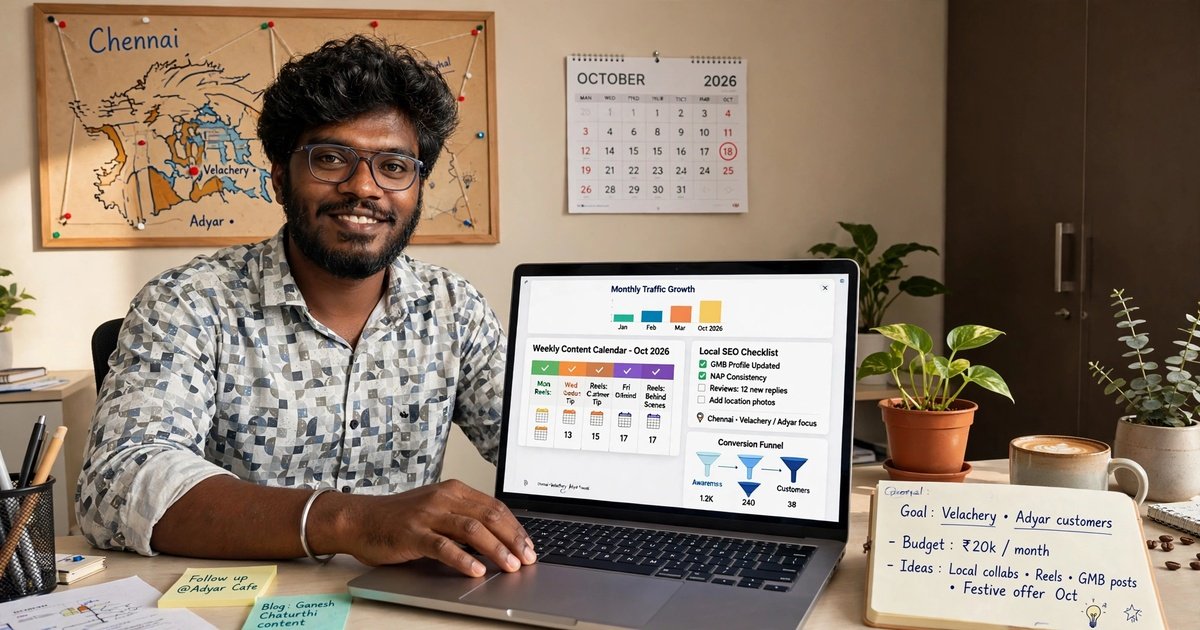
A small set of metrics, checked consistently, tells you more than a large dashboard checked rarely. The following four categories cover what actually matters for most small businesses.
Sessions, bounce rate and time on key pages indicate whether visitors are actually engaging with your site or leaving immediately — useful for spotting a website problem before it quietly undermines every other channel.
Keyword rankings, organic clicks and impressions for the searches that matter to your business show whether your visibility in search is moving in the right direction, even before that translates into enquiries.
Cost per click is worth watching, but cost per enquiry or cost per conversion matters more — a campaign with a high click cost that reliably produces enquiries is usually worth more than a cheap one that does not.
Ultimately, enquiries, footfall and repeat orders are what channel-level metrics are meant to explain. If the business metrics are not moving, it is worth revisiting the strategy itself rather than only optimising individual campaigns.
None of this needs to be adopted all at once. Pick the one or two channels that most directly match your current goal and audience, fix the basics on your website and Google Business Profile first, and add further channels only once the first ones are consistently working. A focused strategy, revisited every few months as the business changes, will almost always outperform a broad but shallow presence across every platform at once.
For a broader look at how search, ads, social and your website fit together as a system rather than separate efforts, see how a digital marketing agency helps Chennai businesses grow online.
If you would rather have this planning done for you, our team can help — browse our services or get in touch to talk through what would fit your business.
It depends heavily on the goal and industry, but the more useful question is how the budget is split — enough should go toward fixing the website and Google Business Profile before any of it goes toward ads, since ads sending traffic to a weak website waste spend.
For most locally-serving businesses, local SEO and an accurate Google Business Profile are the highest-leverage starting point, since they capture people already searching nearby. Businesses selling to a wider audience or a considered purchase often get more from a strong website and targeted search ads first.
Paid ads can produce enquiries within days once tracking and targeting are set up correctly. SEO and content typically take a few months to show meaningful movement, and social media usually needs consistent posting over a similar timeframe before it reliably contributes to enquiries.
Yes, particularly in the early stages — a website, Google Business Profile and one social channel are manageable in-house with some consistency. As the number of channels and the complexity of tracking grows, many businesses bring in outside help to keep everything running without it becoming a full-time job for someone.
Want results like this for your own business?
Get a Free Consultation