11JUL


Most businesses do not arrive at digital marketing with a strategy. They arrive with a handful of disconnected experiments — a website built three years ago, an Instagram account someone updates when there is time, an ad campaign that ran for two months, a vague sense that the phone should be ringing more. Each piece may be fine on its own. What is usually missing is the connection between them.
That connection is the main thing a digital marketing agency brings. Not a secret channel nobody else knows about, but a way of making search, advertising, social media, content and your website support each other instead of running as separate, unmeasured efforts. This guide walks through what each piece actually contributes, so you can judge for yourself which parts your business is missing. For a step-by-step way to turn this into a plan for your own business, see our guide to building a digital marketing strategy for small businesses.
Strip away the jargon and the work falls into four repeating activities: deciding which channels deserve your budget, executing the day-to-day work in those channels, measuring what each one produces, and reallocating based on what the measurement shows. The channels are just tools. The discipline is in the loop.
A business can absolutely do all of this in-house. The question is usually whether one person can cover technical SEO, ad account management, content production, design and analytics well enough, consistently enough, alongside everything else they are responsible for.
Search is the most valuable channel for most service businesses for one reason: the person is already looking. They have a problem, they have typed it into Google, and they are actively choosing between options. You are not interrupting anyone — you are just trying to be present at the moment of decision.
Getting there is slow and cumulative. It involves fixing the technical foundations of your site, building pages that genuinely answer what people search for, and earning enough credibility that Google is willing to rank you above established competitors — the work covered by ongoing SEO services. None of it produces results in week one, which is exactly why businesses abandon it too early.
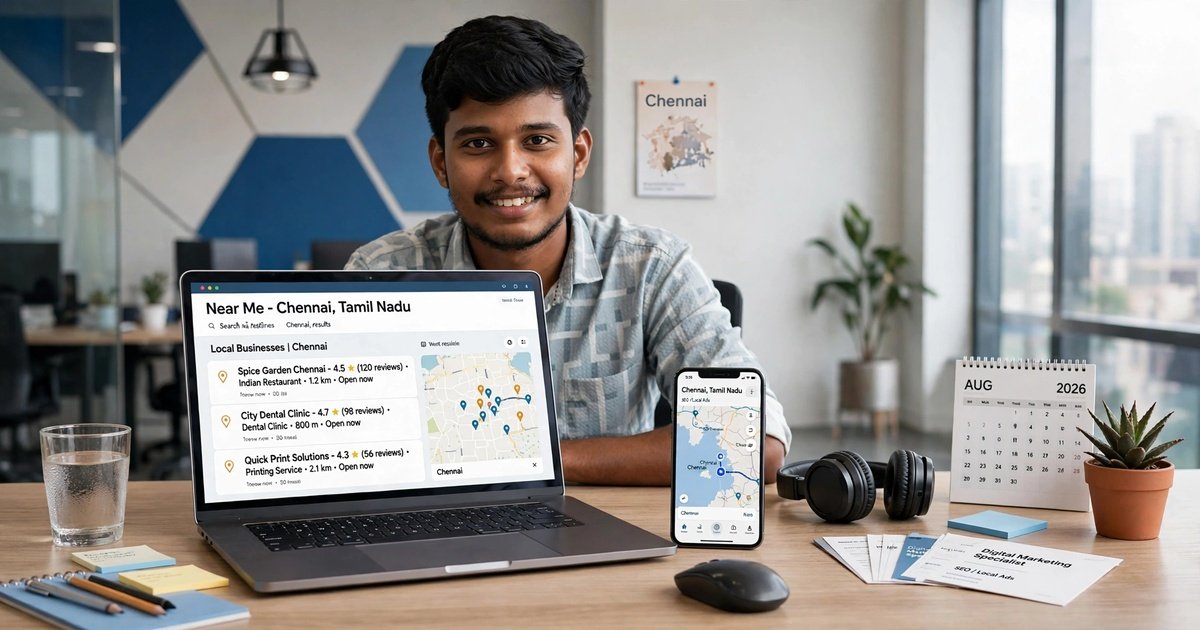
For a business serving customers in a specific city, a large share of search value sits in the map results rather than the blue links — which depends on your Google Business Profile, consistent contact details across the web, and reviews far more than on your homepage copy. We covered that in detail in our guide to local SEO for Chennai businesses.
Paid advertising solves the timing problem that SEO creates. A campaign can be live within days, and you find out quickly whether people actually want what you are selling at the price you are selling it. Well-run Google Ads and PPC campaigns are less about writing clever ads and more about relentlessly removing the searches that waste money and doubling down on the ones that convert.
The trade-off is obvious but worth stating: the results stop when the spending stops. Paid and organic work best as a pair — ads buy you visibility and data now, while search and content build an asset that keeps working after the budget moves elsewhere.
Where the first budget should go depends on whether people already search for what you offer, or whether they need to see it to understand it. That distinction is the whole argument in our comparison of Google Ads and Meta Ads, and it is worth settling before spending anything.
Social media works on a different logic from search. Nobody opens Instagram looking for a supplier. What social media marketing does well is familiarity — showing the work, the people and the thinking behind a business often enough that when a need eventually arises, you are already a known quantity rather than a search result.
This is also the channel where consistency beats budget most clearly. An account that posts modestly but reliably tends to outperform one that produces something polished every few months, because both the platforms and the audience reward showing up.
Every channel above ends at the same destination. If the site is slow, awkward on a phone, or unclear about what you do and what to do next, then improving the marketing simply sends more people to a leaky page. This is why a properly built business website is usually the first thing an agency looks at, not the last.
Whether that means adjusting what exists or starting again is a genuine judgement call, and an expensive one to get wrong — redesign versus rebuild walks through how to tell which situation you are actually in.
Content is not a separate channel so much as the raw material the others run on. Search needs pages worth ranking, social needs something worth posting, and ads need landing pages that answer objections. Treating content marketing as an extension of your sales conversations — writing down the questions prospects ask every week — tends to produce far more useful material than brainstorming topics in isolation.
Run separately, each channel gives you a modest return. Run together, they start feeding each other: an article written for search becomes a social post, which reaches people who later search for your brand by name, which makes your ads cheaper because more people recognise and click them, which sends more data back into the campaigns. None of these effects is dramatic on its own. Together, over months, they are the difference between marketing that plateaus and marketing that compounds.
That compounding is also why a channel-by-channel scorecard can be misleading. The honest question is not which channel performed best last month, but whether the overall system is producing more enquiries at a sustainable cost than it did a quarter ago.
Expect different channels to mature at different speeds. Paid campaigns produce data almost immediately and usually need several rounds of refinement before the cost per enquiry settles. Social builds slowly and shows up first in engagement, then in brand searches. Search and content are the slowest to move and the last to be judged fairly — the work done in the first month is often what shows up in results months later.
The practical implication is to agree up front on what will be measured, when, and against what baseline. A plan with no agreed measurement is impossible to judge, and a plan judged after four weeks will almost always be abandoned before its slowest and most valuable parts have had a chance to work.
If you want to see how one team puts these pieces together in practice, this is how we approach digital marketing for businesses in Chennai — and the checklist in our article on choosing an agency is a fair way to judge us or anyone else.
No. Most businesses are better off funding one or two channels properly than spreading a small budget thinly across five, and adding channels as results and capacity allow.
An agency spreads the work across specialists in search, ads, content and design, while a single hire covers all of it alone. The right choice depends on your workload, budget and how quickly you need momentum.
A clear commercial goal, a realistic budget range, access to any existing ad accounts and analytics, and an honest summary of what has already been tried — these make the first conversation far more useful.
This article covers the thinking behind our Explore Our Services work — see that page for what the scope, process and deliverables usually look like.
Explore Explore Our ServicesWant results like this for your own business?
Get a Free Consultation