23JAN

A huge share of buying decisions now start with a "near me" search — a customer typing "digital marketing agency near me" or "best bakery in Anna Nagar" and picking from whoever shows up first. If your business is not visible in that moment, the sale goes to a competitor, even if your product or service is better.
Local search is worth treating separately from the rest of SEO because it is decided differently. A page can rank respectably in the ordinary results and still be invisible in the map pack sitting above them, because the map pack is ranked largely on signals that have nothing to do with your website.
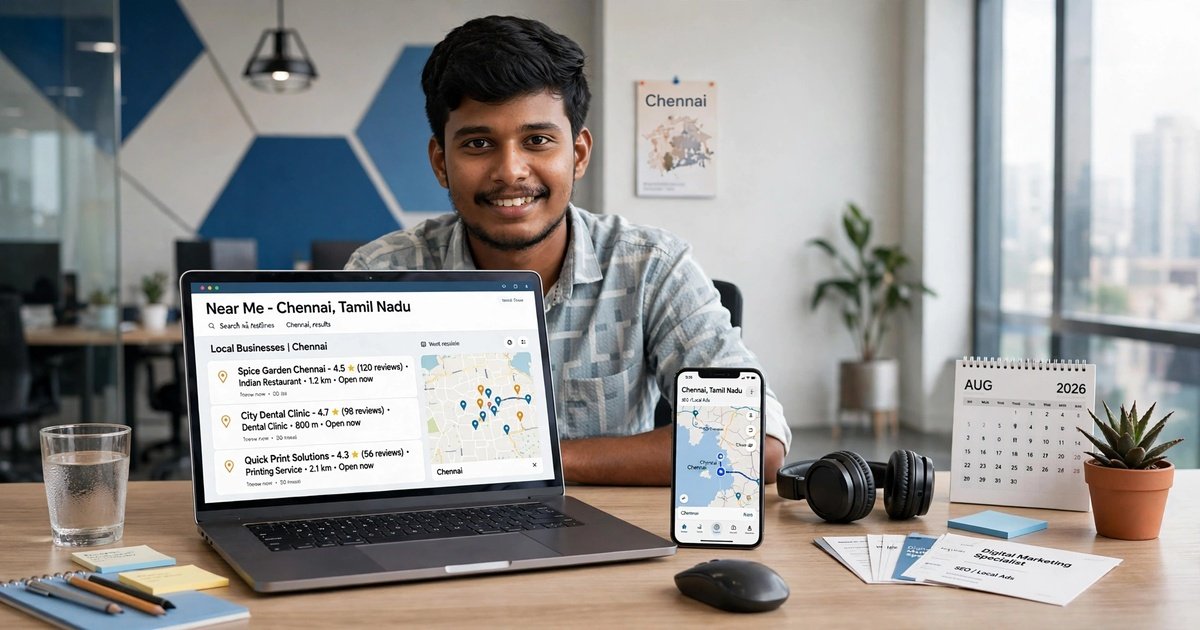
When someone searches for a local service, Google usually shows a map with three businesses pinned to it, and below that the standard list of web pages. The map results are drawn from Google Business Profiles and weigh proximity, prominence and relevance. The links below are drawn from web pages and weigh the usual mix of content, links and technical health.
This matters because the two need different work. Improving your website will not, on its own, move you into the map pack. Optimising your Business Profile will not, on its own, make a service page rank. Most local businesses need both, and most are doing only one.
Your Google Business Profile is the single most important local SEO asset you own. It needs an accurate category, complete business hours, real photos, and a description that mentions the areas you serve. Incomplete or outdated profiles quietly lose you the map-pack ranking that most local clicks come from.
The primary category is the strongest single field in the profile, and it is the one most often chosen carelessly. Pick the category that describes what you primarily are, not the broadest one available, then add secondary categories for genuine additional services. Look at what the businesses currently ranking in your area have chosen — it is public, and it tells you which category Google associates with the search you want to win.
The services list, the products section, the opening-date field, the attributes, the appointment link and the Q&A section are all part of the profile and all commonly left empty. None of them is transformative alone. Collectively they are the difference between a profile Google can confidently match to a specific query and one it can only match vaguely.
Photos are worth a standing habit rather than a one-time upload. Genuine interior, exterior, team and work photos, added periodically, give the profile signs of life. Posts work the same way — a short update every couple of weeks is enough to keep the profile from looking abandoned.
Your business name, address, and phone number (NAP) should be identical across your website, Google Business Profile, and every directory listing. Search engines use this consistency as a trust signal — mismatched addresses or phone numbers across the web quietly hold back local rankings even when everything else is done well.
The usual culprits are predictable: an old office address left on a directory after a move, a landline that was replaced by a mobile number, a business name written three different ways across listings, or a suite number present in some places and missing in others. Audit these by searching for your own phone number and business name in quotes and seeing what comes back.
Fix the biggest directories first, then your own website footer and contact page, then the long tail. This is unglamorous work that nobody enjoys, which is precisely why it is often the cheapest available advantage.
Reviews influence where you rank and whether anyone clicks once you do. A steady stream of recent, genuine reviews — and thoughtful replies to them — tells both Google and potential customers that your business is active and trustworthy. Asking happy customers for a review right after a good experience is one of the highest-return, lowest-cost things a local business can do.
Two practical points. First, a steady trickle reads as more credible than a sudden burst, and a burst after months of silence looks exactly like what it usually is. Second, reply to everything, including the negative ones. A calm, specific reply to a bad review reassures the next reader far more than the absence of bad reviews would.
Never buy reviews or write them yourself. Beyond the obvious policy problems, invented reviews are usually recognisable to the customers you are trying to convince — they lack the specific detail that real ones carry.
Generic homepage copy rarely ranks for local searches. Dedicated pages for each service and each area you serve — with real, specific content rather than the same paragraph repeated with the city name swapped — give search engines far more to work with, and give customers proof you actually operate where they are searching from.
The test for whether an area page deserves to exist is simple: could you write three paragraphs about serving customers in that specific area that would be wrong if you pasted them onto a different area page? If yes, the page is worth building. If no, you are producing near-duplicates that dilute each other and rarely rank.
As an example, see the Chennai areas NuerixDigital serves for a locality-by-locality look at how this plays out across the city.
Website sessions are a poor measure of local SEO, because a large share of local wins never reach your website at all. Someone finds you in the map pack, taps the call button, and becomes a customer without loading a single page of your site.
Watching the split between discovery searches and brand searches is particularly useful. Growth in brand searches means people are hearing about you elsewhere; growth in discovery searches means your local visibility is genuinely improving.
Spend the first few weeks on the fixed assets: profile completeness, categories, NAP consistency, and the on-page basics of your main service pages. These are one-time corrections that keep paying afterwards. Then move into the recurring habits — review requests, photos, posts, and building out genuinely distinct service and area pages.
Local SEO is not a one-time setup; it is a habit of staying accurate, active, and specific. Businesses that treat it that way consistently outrank competitors who set it up once and forget about it.
Local search is one part of a wider picture — how the channels fit together is worth reading before deciding where your budget should go first.
And once you have a sense of the wider picture, our guide to building a digital marketing strategy for small businesses walks through how to sequence that budget channel by channel.
If you're looking for a digital marketing agency in Chennai to help put these fundamentals in place, get in touch for a free consultation.
Most Chennai businesses start seeing map-pack movement within 4–8 weeks of consistent optimization, with stronger gains after 3–6 months.
It is the biggest single factor, but pairing it with consistent NAP data, reviews, and localized on-page content produces noticeably better and more durable results.
Proximity to the searcher is a real factor in map results, so a business will generally rank more easily for searches close to its registered address. Strong reviews, a complete profile and genuinely relevant content widen that radius, but they do not remove distance as a factor entirely.
Only where you can write genuinely different, specific content for each one. Near-duplicate pages that swap the area name tend to compete with each other and rarely rank well, so fewer substantial pages usually outperform many thin ones.
This article covers the thinking behind our SEO Services work — see that page for what the scope, process and deliverables usually look like.
Explore SEO ServicesWant results like this for your own business?
Get a Free Consultation